The Clean Air Board of Central Pennsylvania is a faith-based citizens’ initiative dedicated to creating clean air to protect the health of our children, ourselves, and our neighbors.
What is PM2.5?
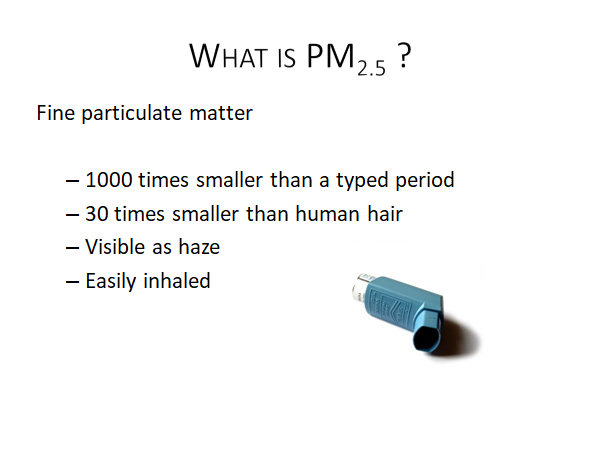 The US Environmental Protection Agency sets national air quality standards for harmful fine particle pollution, including soot (known as PM2.5). These microscopic particles can penetrate deep into the lungs and have been linked to a wide range of serious health effects, including premature death, heart attacks, and strokes, as well as acute bronchitis and aggravated asthma among children. The less PM2.5 we breathe, the better for our health.
What other pollutants cause concern?
Ozone (O3), Nitrogen Dioxide (NO2), Sulfur Dioxide (SO2), Lead (Pb), and Carbon Monoxide (CO) are also pollutants of concern, for which the US Environmental Protection Agency has set national ambient air quality standards.
The US Environmental Protection Agency monitors these pollutants and issues daily regional reports of the Air Quality Index. Click on the AirNow link on this page to see today’s report.

Impacts on children.
Children are among the most sensitive to air pollution. Children spend mor time engaged in vigorous activities outdoors than adults. When children run and play, they breathe in more air and, therefore, more pollution is taken into their lungs.

Pulmonary and cardiac issues.
Particle pollution—like that coming from that exhaust smoke—is very harmful. Particle pollution can increase the risk of heart disease, lung cancer and asthma attacks. PM.5 can interfere with the growth and work of the lungs.
Neurologic issues.
Medical science is now recognizing that particle pollution has effects beyond the heart and lungs. Small particles can be transmitted into the blood stream to the brain and interfere with neurological functions.


