
CAB will host community forum on data centers on May 21
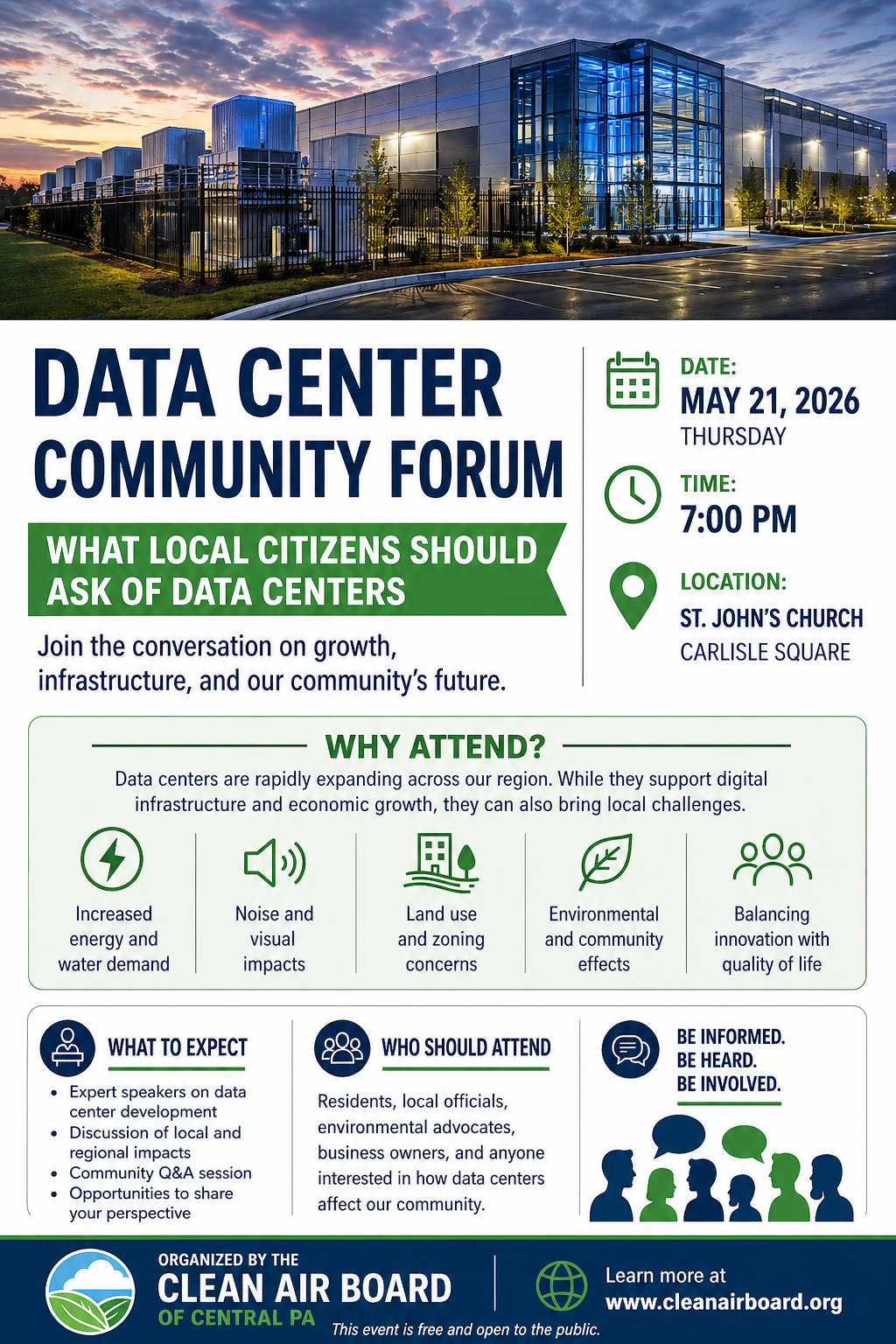
Join us in person or on Zoom. St. John’s Episcopal Church, May 21, 7 pm. To register for a Zoom link, please click this:
https://us02web.zoom.us/

Join us in person or on Zoom. St. John’s Episcopal Church, May 21, 7 pm. To register for a Zoom link, please click this:
https://us02web.zoom.us/
The Commonwealth Court just dealt a blow to Pennsylvania’s plan of joining the Regional Greenhouse Gas Initiative (RGGI), a cap-and-invest program that would reduce climate pollution and invest in local communities.
Given that Pennsylvania is the nation’s fourth largest emitter of carbon dioxide, joining RGGI would help reduce climate-warming emissions and support climate change initiatives.
It’s imperative that Governor Shapiro act quickly and appeal this decision to the state Supreme Court. Send a message to the Governor to voice your support for RGGI and urge him to appeal the decision.
RGGI would require regulated fossil fuel power plants to purchase allowances for the carbon emissions they produce. These funds can then go towards projects like renewable energy development, clean energy job programs, and more energy efficient buildings.
RGGI currently includes 11 participating states and has a proven track record of reducing emissions while jumpstarting climate change initiatives. Although Pennsylvania officially entered into RGGI in April 2022, multiple lawsuits and proposed anti-RGGI legislation have caused Pennsylvania to miss out on over 1.5 billion dollars in RGGI proceeds.
This recent Commonwealth Court ruling found RGGI allowances to be a tax, thereby making the implementation of RGGI unconstitutional unless it is done through the legislative process. Nevertheless, as the Governor’s RGGI Working Group memo concluded, RGGI still remains the best option for creating jobs, tackling climate change, and ensuring affordable energy. Governor Shapiro has 30 days to appeal to the state Supreme Court.
Tell Governor Shapiro that Pennsylvanians want RGGI. The Governor must act now and continue supporting RGGI as the best way forward in reducing climate-warming emissions and investing in Pennsylvania.
March 27, 2023 – The Clean Air Board of Central Pennsylvania submitted comments to the US Environmental Protection Agency on proposed revisions to the air quality standards for fine particulate (soot). CAB urged EPA to tighten the standards to protect vulnerable populations and the general public. Recent medical studies have shown that even low levels of airborne soot pollution can cause harmful health problems. CAB asked EPA to adopt an annual standard of 8 micrograms per cubic meter (8 ug/m3) and a 24-hour standard of 25 micrograms per cubic meter (25 ug/m3). Read the CAB comments.
American Lung Association issues its “State of the Air” report.
www.pennlive.com/news/2021/04/threats-of-breathing-polluted-air-in-central-pa-remains
| A(n) Air Quality Action Day has been declared for Susquehanna Valley, PA, on Sunday, Dec 20 | ||||
|---|---|---|---|---|
| Tomorrow’s Forecast | ||||
| Sunday, Dec 20: | 103 AQI | Unhealthy for Sensitive Groups |  |
Particle Pollution (2.5 microns) |
|
|
||||
| Extended Forecast | ||||
| Monday, Dec 21: | 64 AQI | Moderate |  |
Particle Pollution (2.5 microns) |
| Tuesday, Dec 22: | 39 AQI | Good |  |
Particle Pollution (2.5 microns) |
| Current conditions: An Air Quality Action Day is effect for the day Sunday. Stagnant surface winds, a moderately strong inversion, and snow cover will all act to bring fine particulate matter (PM2.5) concentrations to the code ORANGE range Sunday. Concentrations will be highest during the morning hours, and then fall some during the afternoon with a slight south wind. The day will turn out mostly cloudy with only a rain or snow shower. *** Monday’s forecast: Another weak weather system will bring a rain or snow shower later Monday or Monday evening with enough low level mixing from the south and southwest to where only moderate PM2.5 concentrations are expected. *** Extended forecast: Better air quality in the good range is expected by Tuesday, as a northwesterly flow will increase and be rather brisk in the afternoon. High pressure builds back in by Wednesday, but then a strong cold front brings rain to the area Christmas eve. A blast of very cold air will then follow for Christmas day and Saturday. Air quality should be in the good range Wednesday through Saturday.—McAuliffe |
• Conserving electricity by setting air conditioning to a higher temperature;
• Combining errands to reduce vehicle trips;
• Limiting engine idling; and
• Refueling cars and trucks after dusk.
Days when particle pollution levels are expected to be high:
* Reduce or eliminate fireplace and wood stove use.
* Avoid using gas-powered lawn and garden equipment.
* Avoid burning leaves, trash and other materials.
U.S. pollution regulations meant to protect people from dirty air are also saving North America’s birds, according to a new study. Improved air quality under a federal program to reduce ozone pollution may have averted the loss of 1.5 billion birds during the past 40 years, the study found. That’s nearly 20% of bird life in the United States today. Read more.
Our PurpleAir network helps us understand local air pollution. PurpleAir provides continuous monitoring for particulate pollution. Read our Guest Editorial in Cumberlink.
View the recent CAB Zoom meeting where we discuss the air pollution caused by western wildfires and the readings at air quality monitors around major cities on the west coast. https://cleanairboard.com/wp-content/uploads/2020/09/Wildfires.mp4
Wildfires can cause temporary large increases in outdoor airborne particles, and substantial increases in gaseous air pollutants such as carbon monoxide, nitrogen dioxide, formaldehyde, and acetaldehyde. Large wildfires can increase air pollution over thousands of square kilometers [or thousands of square miles].
A high-tech sensor network brought me closer to the natural cycles of my environment.
NY Times, Sept. 4, 2020.
By
Contributing Opinion Writer

