PurpleAir Can Warn of Hazardous Air
I Live in California. How Do I Know It’s Safe to Go Outside?
A high-tech sensor network brought me closer to the natural cycles of my environment.
NY Times, Sept. 4, 2020.
By
Contributing Opinion Writer
A high-tech sensor network brought me closer to the natural cycles of my environment.
NY Times, Sept. 4, 2020.
By Annalee Newitz
Contributing Opinion Writer
The Pennsylvania Department of Environmental Protection (DEP) has issued a Code Orange Air Quality Action Day for ozone for Monday, August 10, 2020, for the counties of Bucks, Chester, Delaware, Montgomery, and Philadelphia in southeastern Pennsylvania, the counties of Cumberland, Dauphin, Lancaster, Lebanon, and York in southcentral Pennsylvania, and the counties of Allegheny, Armstrong, Beaver, […]
The Clean Air Board announced that it has installed a new air quality monitor in downtown Carlisle near the Square. The PM2.5 sensor will report its readings 24 hours a day. The real-time data can be viewed on the PurpleAir network. The PurpleAir™ sensor is a device that uses two laser particle counters to capture and record data about microscopic particulate matter (PM2.5) suspended in the air. The sensor uses WiFi connectivity to display real-time air quality readings on the PurpleAir™ Map, which is a world-wide map of monitors where data can be shared with the public.

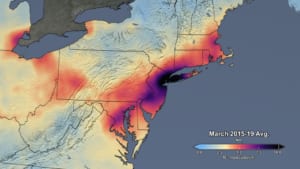
Over the past several weeks, NASA satellite measurements have revealed significant reductions in air pollution over the major metropolitan areas of the Northeast United States. Similar reductions have been observed in other regions of the world. These recent improvements in air quality have come at a high cost, as communities grapple with widespread lockdowns and shelter-in-place orders as a result of the spread of COVID-19. Read more …
See How the World’s Most Polluted Air Compares With Your City’s
by Nadja Popovich, Blacki Migliozzi, Karthik Patanjali, Anjali Singhvi and Jon HuangDec. 2, 2019
We visualized the damaging, tiny particles that wreak havoc on human health. From the Bay Area to New Delhi, see how the world’s worst pollution compares with your local air.
https://www.nytimes.com/interactive/2019/12/02/climate/air-pollution-compare-ar-ul.html
The Pennsylvania Department of Environmental Protection and its regional air quality partnerships have forecast a Code Orange Air Quality Action Day for ozone on June 16, 2018 for the Pittsburgh region (encompassing Allegheny, Armstrong, Beaver, Butler, Fayette, Indiana, Mercer, Washington, and Westmoreland counties). A Code Orange Air Quality Action Day for ozone is also forecast on June 17 and 18 for the Pittsburgh region, southcentral counties (Cumberland, Dauphin, Lancaster, Lebanon, and York counties) and the Lehigh Valley (Berks, Lehigh, and Northampton counties).
On air quality action days, young children, the elderly and those with respiratory problems, such as asthma, emphysema and bronchitis, are especially vulnerable to the effects of air pollution and should limit outdoor activities.
The U.S. Environmental Protection Agency’s standardized air quality index uses colors to report daily air quality. Green signifies good; yellow means moderate; orange represents unhealthy pollution levels for sensitive people; and red warns of unhealthy pollution levels for all.
To help keep the air healthy, residents and business are encouraged to voluntarily restrict certain pollution-producing activities by:
• Refueling cars and trucks after dusk
• Setting air conditioner thermostats to a higher temperature
• Carpooling or using public transportation; and
• Combining errands to reduce trips.
Summer will soon be here and that can mean high levels of air pollutants in our air, specifically ozone and small particles, commonly known as smog.
Meteorologists declare “Air Quality Action” days when they project that weather conditions are conducive for unhealthy air pollution. In 2016, the Pennsylvania Department of Environmental Protection (DEP) called six action days for the Susquehanna Valley.
We should heed those warnings. Recent scientific studies conclude that short-term exposure to unhealthy air pollution can have significant adverse effects on pregnant women, children, the elderly, and even the general population–especially those with pre-existing conditions such as asthma. Short term symptoms resulting from breathing high levels of ozone and fine particulate are chest pain, coughing, nausea, throat irritation, and congestion. These pollutants also aggravate bronchitis, heart disease, emphysema, and asthma—and can increase risks of stroke. Children, senior citizens, and those with asthma or other respiratory problems are urged to limit outdoor activities when an action day is predicted.
Air Quality Action days are often declared when there is little wind and when the amount of ozone or particles in stagnant air could exceed federal health standards. The DEP monitors local and regional air quality. Local television and radio stations alert the public when an Air Quality Action day is predicted. Check your newspaper’s websites as well. The Clean Air Board of Central Pennsylvania also monitors pollution levels and posts notices at this website when DEP declares an Air Quality Action day. Stay informed!