On July 20, the Clean Air Board and the Clean Air Council submitted joint comments to DEP on its 2026 Air Monitoring Network Plan. The comments noted that there were no DEP monitoring stations located downwind of new data centers and requested DEP include in its plans measures to monitor for pollutants, including PM2.5, NO2, VOCs, and HAPs from these hyperscale data centers, Read the full comments.
https://cleanairboard.com/wp-content/uploads/2019/12/logo-cab-big.png800800Thomas Auhttps://cleanairboard.com/wp-content/uploads/2019/12/logo-cab-pa.pngThomas Au2026-07-21 07:36:112026-07-21 07:36:13Clean Air Board submits comments to DEP Air Monitoring Plan
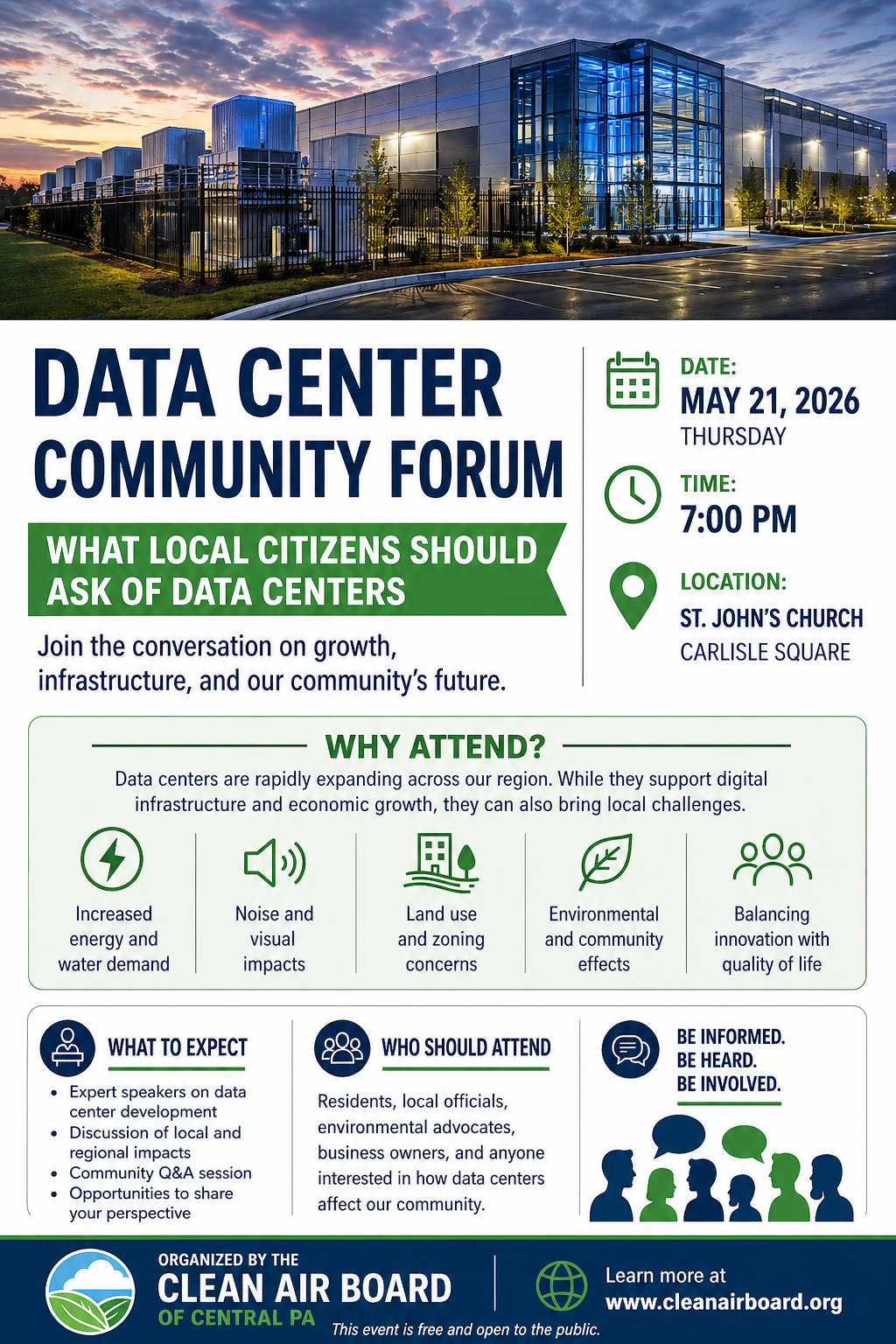
https://cleanairboard.com/wp-content/uploads/2019/12/logo-cab-big.png800800Thomas Auhttps://cleanairboard.com/wp-content/uploads/2019/12/logo-cab-pa.pngThomas Au2026-04-30 20:08:062026-05-07 21:16:06CAB will host community forum on data centers on May 21
Research showed truck-related releases of nitrogen dioxide, which can cause asthma, concentrated around some 150,000 warehouses nationwide. Read more …
https://cleanairboard.com/wp-content/uploads/2019/12/logo-cab-big.png800800Thomas Auhttps://cleanairboard.com/wp-content/uploads/2019/12/logo-cab-pa.pngThomas Au2025-08-25 20:07:552025-08-25 20:07:56Looking From Space, Researchers Find Pollution Spiking Near E-Commerce Hubs
When we think of locally undesirable land uses, we often think of large power plants, puffing single plumes of pollution. But many plumes of pollution from trucks traveling to and from warehouses can have equally large impacts on health. Read more …
Warehouses in the US worsen local air pollution, according to a new study. Using satellite data to study the air quality around nearly 150,000 warehouses, researchers found that nitrogen dioxide levels were 20% higher near warehouses, on average, compared to upwind locations mainly because of the trucks that frequent and idle at these facilities (Nat. Commun. 2024, DOI: 10.1038/s41467-024-50000-0). Read more . . ,
Message from Joseph Otis Minott, Esq., Executive Director and Chief Counsel, Clean Air Council
The Commonwealth Court just dealt a blow to Pennsylvania’s plan of joining the Regional Greenhouse Gas Initiative (RGGI), a cap-and-invest program that would reduce climate pollution and invest in local communities.
Given that Pennsylvania is the nation’s fourth largest emitter of carbon dioxide, joining RGGI would help reduce climate-warming emissions and support climate change initiatives.
RGGI would require regulated fossil fuel power plants to purchase allowances for the carbon emissions they produce. These funds can then go towards projects like renewable energy development, clean energy job programs, and more energy efficient buildings.
RGGI currently includes 11 participating states and has a proven track record of reducing emissions while jumpstarting climate change initiatives. Although Pennsylvania officially entered into RGGI in April 2022, multiple lawsuits and proposed anti-RGGI legislation have caused Pennsylvania to miss out on over 1.5 billion dollars in RGGI proceeds.
This recent Commonwealth Court ruling found RGGI allowances to be a tax, thereby making the implementation of RGGI unconstitutional unless it is done through the legislative process. Nevertheless, as the Governor’s RGGI Working Group memo concluded, RGGI still remains the best option for creating jobs, tackling climate change, and ensuring affordable energy. Governor Shapiro has 30 days to appeal to the state Supreme Court.
https://cleanairboard.com/wp-content/uploads/2019/12/logo-cab-big.png800800Clean Air Boardhttps://cleanairboard.com/wp-content/uploads/2019/12/logo-cab-pa.pngClean Air Board2023-11-08 22:40:172023-11-09 07:43:01Tell Gov. Shapiro: Appeal the RGGI Ruling
Air Pollution Kills 10 Million People a Year. Why Do We Accept That as Normal?
By David Wallace-Wells, Opinion Writer, NY Times, July 8, 2022
For every thousand people alive on earth, 973 are regularly inhaling toxins. Only 27 are not. Which means, almost certainly, you are too.
Last fall, the World Health Organization lowered its global air quality standard from 10 micrograms of particulate matter per cubic meter to five. Those terms and standards can feel abstract, which makes their meaning a bit hard to fathom. Read more . . .
https://cleanairboard.com/wp-content/uploads/2019/12/logo-cab-big.png800800Clean Air Boardhttps://cleanairboard.com/wp-content/uploads/2019/12/logo-cab-pa.pngClean Air Board2022-07-09 20:10:112023-06-16 15:51:22Air Pollution Kills 10 Million People a Year.
Study: Air pollution laws aimed at human health also help birds
By Pat Leonard |Cornell Chronicle
U.S. pollution regulations meant to protect people from dirty air are also saving North America’s birds, according to a new study. Improved air quality under a federal program to reduce ozone pollution may have averted the loss of 1.5 billion birds during the past 40 years, the study found. That’s nearly 20% of bird life in the United States today. Read more.
https://cleanairboard.com/wp-content/uploads/2019/12/logo-cab-big.png800800Clean Air Boardhttps://cleanairboard.com/wp-content/uploads/2019/12/logo-cab-pa.pngClean Air Board2020-12-08 09:51:302020-12-08 09:52:52Clean Air is Good for Birds too
Washington Post, July 14, 2020. By Dino Grandino. More than a dozen states are teaming up to boost sales of pickup trucks, school buses and big rigs that run entirely on electricity and do not pump climate-warming pollution into the air. Leaders from Massachusetts, New Jersey, New York, North Carolina, Pennsylvania and 10 other states, […]
https://cleanairboard.com/wp-content/uploads/2019/12/logo-cab-big.png800800Clean Air Boardhttps://cleanairboard.com/wp-content/uploads/2019/12/logo-cab-pa.pngClean Air Board2020-07-14 14:47:542020-07-14 14:47:54More than a dozen states unite to boost electric trucks
June 24, 2020 – The Clean Air Board testified at an Environmental Quality Board hearing on DEP’s proposed rules to reduce hydrocarbons and methane leaks from existing oil and gas operations. CAB asked that certain exemptions be removed from the proposed rules. Read CAB’s methane rule comments