

Guest Editorial: The time for air quality monitoring is now | The Sentinel – Central PA Newspaper
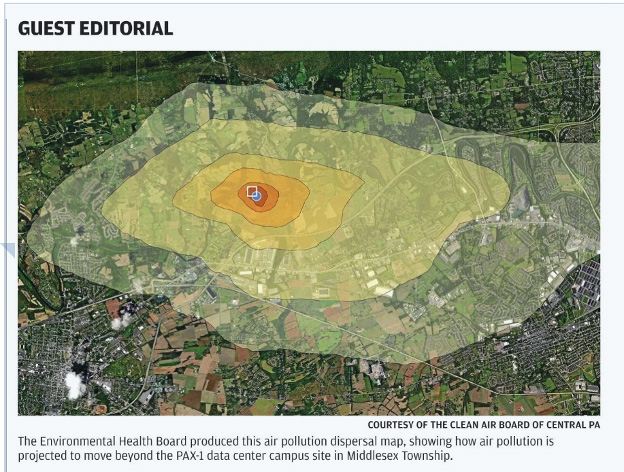
Sustainable development is essential and can be of great benefit to a community. The Clean Air Board of Central PA is recommending that Air Quality Monitoring Programs be included for large construction and demolition-remediation projects in our county. This recommendation is not intended to deter development, but to ensure it is done in a safe way.
Cumberland County’s geography and traffic volume present a persistent challenge to maintaining clean air – critical to protecting our health and quality of life. The Clean Air Board of Central PA was formed following a report about deteriorating air quality in our area, signed by over 100 local physicians. Many residents are unaware of the air pollution released during data center construction, such as the Middlesex Township PAX-1 site, and at brownfield site demolition/remediation projects like that taking place at the former Frog, Switch factory site. Both are in close proximity to residential areas, with Frog, Switch right in downtown Carlisle. Our citizens are rightfully concerned about the rapid expansion of data center projects for a variety of reasons, including community health.
Why is air monitoring important? There is no safe level of PM2.5 (microscopic particles that penetrate deep into our lungs and circulate to all vital organs). Poor air quality is linked to heart attacks, strokes, neurological problems, pulmonary diseases such as asthma, and reproductive problems including reduced fetal growth and preterm birth, according to the PA Department of Health. Groups at greatest risk are children, the elderly and pregnant women – together representing over 40% of Cumberland County’s population, according to PA DOH Health Profiles.
PM2.5 particles are undetectable without a microscope or special sensors (air monitors). The higher the PM2.5 level the greater the risk to individuals. Air pollution travels miles from the source and unmeasured levels of dangerous air pollutants risk the health and safety of the surrounding community.
What is an Air Quality Monitoring Program? An AQM is two essential components: 1. Air monitors around the perimeter of the site and 2. Actions required by the contractor to prevent the escape of toxic pollutants from the construction site. The Clean Air Board of Central PA and others have placed air monitors for particulate matter (PM2.5 and PM10) throughout the area, but these do not measure other airborne pollutants such as silica, nitrogen oxides, sulfur dioxide, carbon monoxide, hydrocarbons and volatile organic compounds from blasting, excavation and diesel emissions from heavy construction equipment, traffic and generators.
Air Quality Monitoring is standard practice in New York and other states for demolition/remediation projects. A Community Air Monitoring Plan for a 700-acre construction site near Philadelphia includes perimeter site air monitors and units in adjacent neighborhoods. It is not unusual or unreasonable to ask developers to measure the levels and types of pollutants, and to have defined mitigation actions based on the results. Today’s air monitors are mobile, solar powered and provide real time results to the public with critical information, hopefully showing no negative impacts.
Pennsylvania does not require air monitoring for most construction and demolition projects, but both the US EPA and DEP have required it when hazardous airborne or volatile substances are present. Dust suppression and periodic visual inspections by DEP are standard for most projects, but does not guarantee safe air quality. A visual assessment cannot detect microscopic dust or pollutants in the atmosphere that are released during the construction and demolition/remediation activities.
The Clean Air Board of Central PA is in communication with the developers of PAX-1 and the Frog, Switch demolition/remediation sites to add Air Quality Monitoring to their projects, but there is no assurance it will be done since construction, demolition and earth disturbance have already been started.
Municipalities should add an Air Quality Monitoring program to their current zoning and permitting approvals for these types of projects. For demolition and remediation sites, Pennsylvania only requires aggressive outreach for public involvement if the municipality requests it. Communities must be aware that their only opportunity to have meaningful public comment rests upon their asking for a public involvement plan upon receipt of the Notice of Intent to Remediate (NIR), during which air quality and other environmental safeguards can be made.
Gov. Josh Shapiro’s Executive Order (EO 2026-05) does not grant local governments new legal authority but empowers municipalities and the developers to agree to special specific site-mitigation measures such as air monitors.
We hope that as good neighbors, the developers of the PAX-1 and Frog, Switch will commit to an Air Quality Monitoring program for the duration of both projects. The citizens have a right to breathe clean air and have peace of mind regarding their health and well-being of the community. Now is the time to add Air Quality Monitoring to these projects.
Dr. Frank Castrina is a resident of Carlisle, former internal medicine physician and current member of the Clean Air Board of Central PA.


Leave a Reply
Want to join the discussion?Feel free to contribute!